

VITÓRIA CRIBB
By Clarissa Diniz
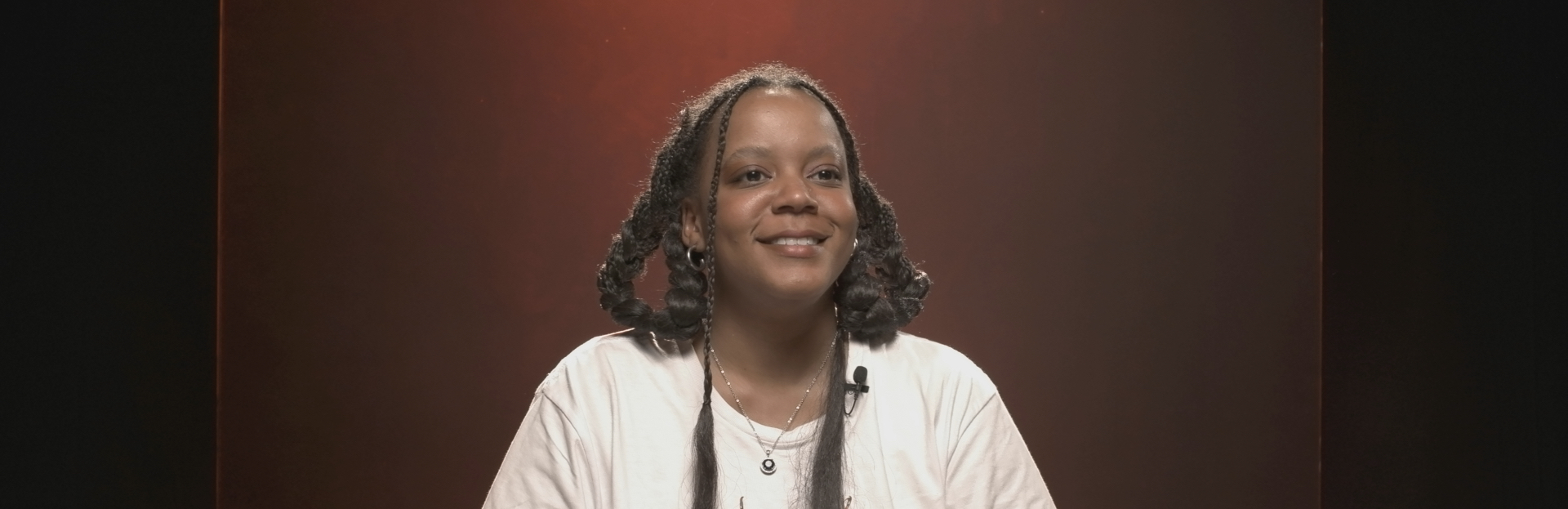
From an early age, Vitória Cribb (Rio de Janeiro, 1996) was encouraged by her parents—her Haitian father and Brazilian mother, both engineers—to explore computers, the internet, games, and other technologies as part of the joyful investigation of the world typical of childhood. In this context, the digital universe didn’t present itself to the artist as a belated or instrumentalized tool for study or work purposes, but as her original playing territory. As a device for continuous experimentation—unaffected by the prescriptive logic of trial and error—the machine was a constant presence in Cribb’s process of self-invention. From this early affinity with computational environments and interactive interfaces emerges her work: a practice grounded in an immemorial relationship with technology that is at one time intimate, critical, and imaginative.
From this close implication between creation, body, and technology emerges one of Vitória Cribb’s poetic and political principles: the inseparability between subjects and machines and their unique regimes of attention and meaning. Her education at the Higher School of Industrial Design (ESDI/UERJ, 2015–2020) consolidated this initial link by offering tools to systematically put together artistic practice and technological development. In the field of design, the artist found an expanded field in which aesthetics, functionality, and politics interweave, allowing her to simultaneously operate in the realms of the sensory and the technical.
Her practice in the field of augmented reality (AR) and extended reality (XR) draws on the institutional frameworks of the arts and through BTWN Studios—the commercial arm of her work, with productions in the field of AR lenses, 3D avatars, and VR environments, among others. Since 2020, with BTWN, Cribb has been part of Snapchat’s official lens creators program, developing numerous works for other authors, brands, and technology platforms—an intense production of images and videos which, circulating through different worlds and uses, also incorporates a critical dimension towards the technologies it mobilizes.
As a Black woman, the racialization of technologies is a central part of her critical perspective, an emblematic aspect already evident in her first film, Command Prompt (2019). In it, Cribb establishes analogies between the Black body and the digital body: a reflection that returns in different works, always enriched by transversal issues such as gender, mental health, necropolitics, and surveillance. By alternating and converging the terms “black” and “digital,” the film reveals how white racial supremacy and its various sociopolitical technologies have reduced other subjects and forms of knowledge to something invisible, servile, and de-subjectified: “my body has always been virtual, untouchable, / unloved and a source of curiosity.”
Command Prompt has been screened at national and international cultural institutions and festivals, paving the way for a hybrid trajectory, combining biennials, group shows, audiovisual circuits, and advertising jobs. Her presence at the Biennial Sesc_Videobrasil (2023), where she received the Wexner Center for the Arts Residency Award (2026), as well as at such events as SXSW (2022) and the Glasgow Short Film Festival (2026), demonstrates the consistent circulation of Cribb’s work within the circuits of contemporary art and experimental cinema. The artist’s transit through different symbolic fields, markets, and audiences reveals itself as a political premise that rejects the traditional elitism of the visual arts in the face of today’s diversity of imaginaries and forms of creation.
Not surprisingly, her work is full of references to different ways of conceiving space. In Command Prompt the black background of the screen emerges as a double metaphor for cyberspace and Kalunga Grande—both navigated by Black and digital bodies—in later works the avatars appear in flaccid, aseptic, and disidentified spatialities, as in BUGs (2023) and @ILUSÃO (2020), the latter part of the PIPA Prize 2022 exhibition (Paço Imperial, Rio de Janeiro), which, in that year, awarded Vitória Cribb.
If, on the one hand, these scenarios approach the topological infinitude of cyberspace (of which they become a mirror and metaphor), on the other hand they reveal spatialities whose elasticity converges on the metamorphic plots of Cribb’s films, thus reimagining the relationships between space, time, and identity.
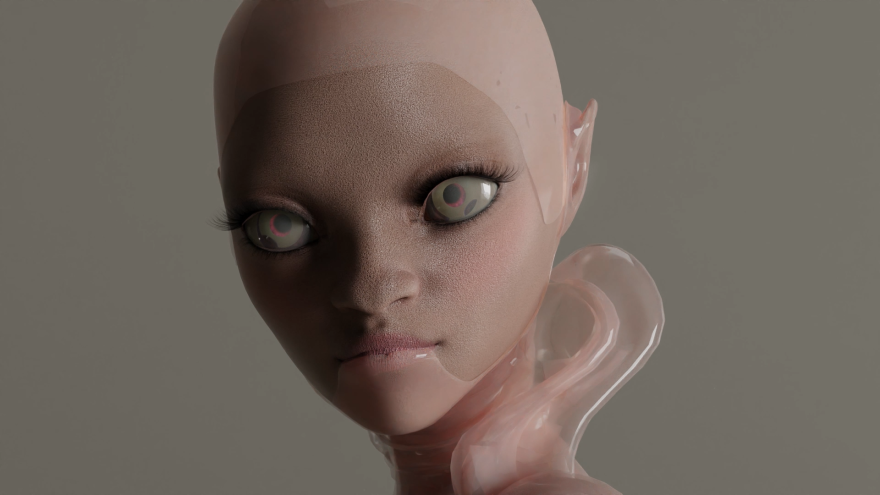
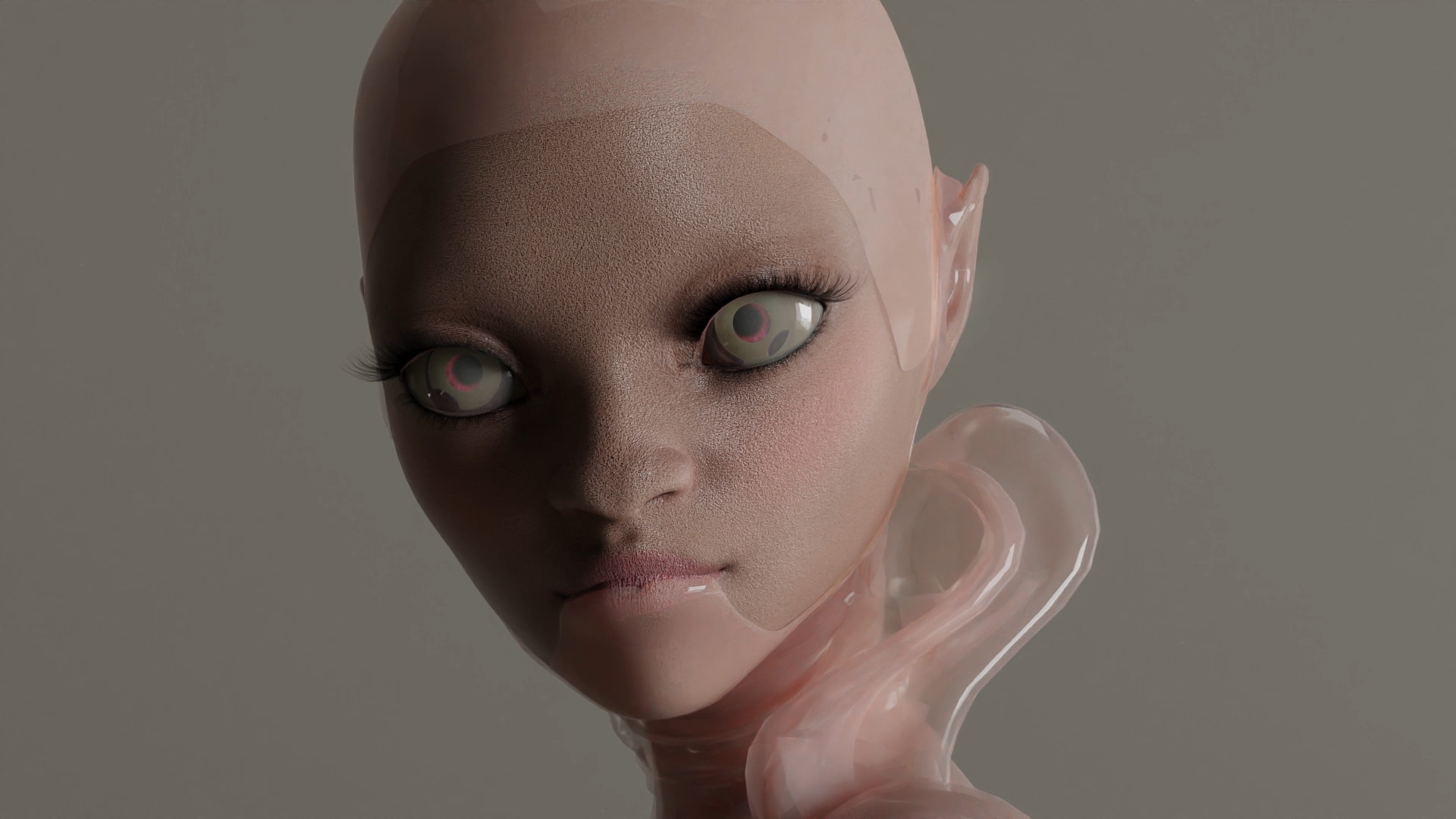
In this regard, her film Spiral (2024), commissioned by INURED (Interuniversity Institute for Research and Development, Haiti), becomes iconic. In it, one of the avatars that inhabit the artist’s imagination embarks on an aquatic quest for the identity that was ransacked from her: “When the figure in front of the mirror becomes unrecognizable, searching for the soul across the water brings comfort.” Produced in collaboration with a Haitian institution—the territory of the artist’s paternal ancestry—Spiral is a political statement on the projections hostilely triggered by the gaze of the other who watches, dehumanizes, silences, distorts, and excludes. By interweaving Black diaspora and digital expansionism, the film outlines the spiraling permanence of coloniality, now in its Web 3.0 version: data colonialism. The relevance of this research is confirmed by Cribb’s presence at such biennials as the 14th Mercosur Biennial (2025), Sharjah Biennial 16 (2025) and Bangkok Art Biennale (2022), as well as by her nomination for awards such as the CIFO-Ars Electronica Award and Ars Electronica.
The _vigilante00 series (2022–2024), comprising the trilogy VIGILANTE_EXTENDED (2022), BUGs (2023) and echoes of a wet finger: (2024), stems from Cribb’s concerns over surveillance in the current version of the internet—in which control intensifies as it is carried out through public and traceable data, and through the participation of users themselves in the monitoring of interactions.
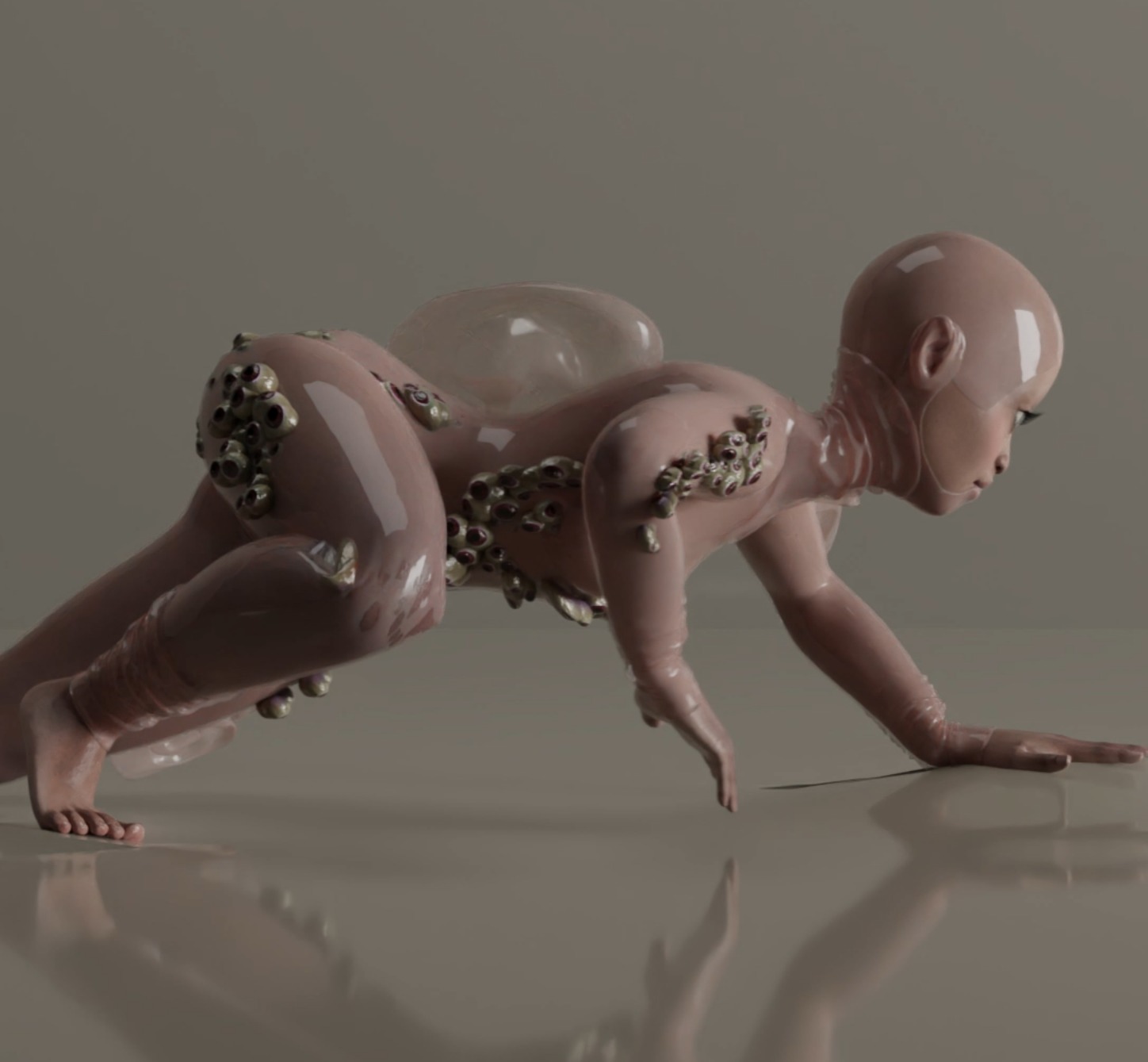
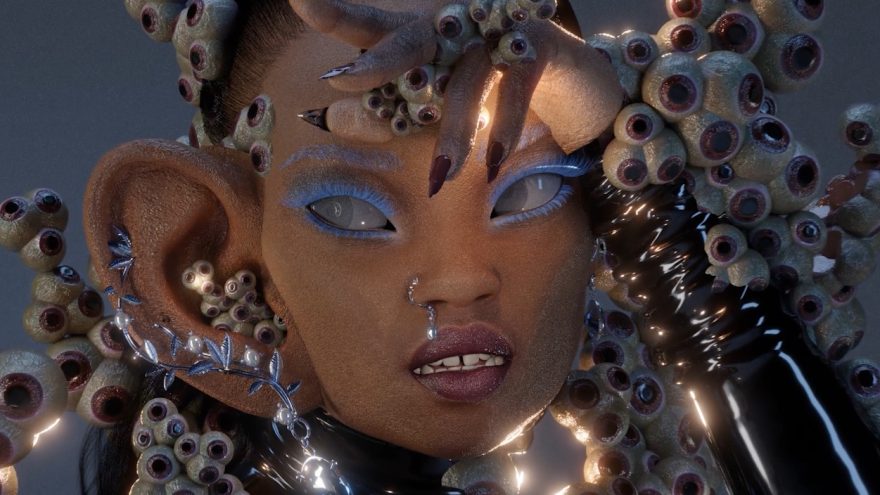
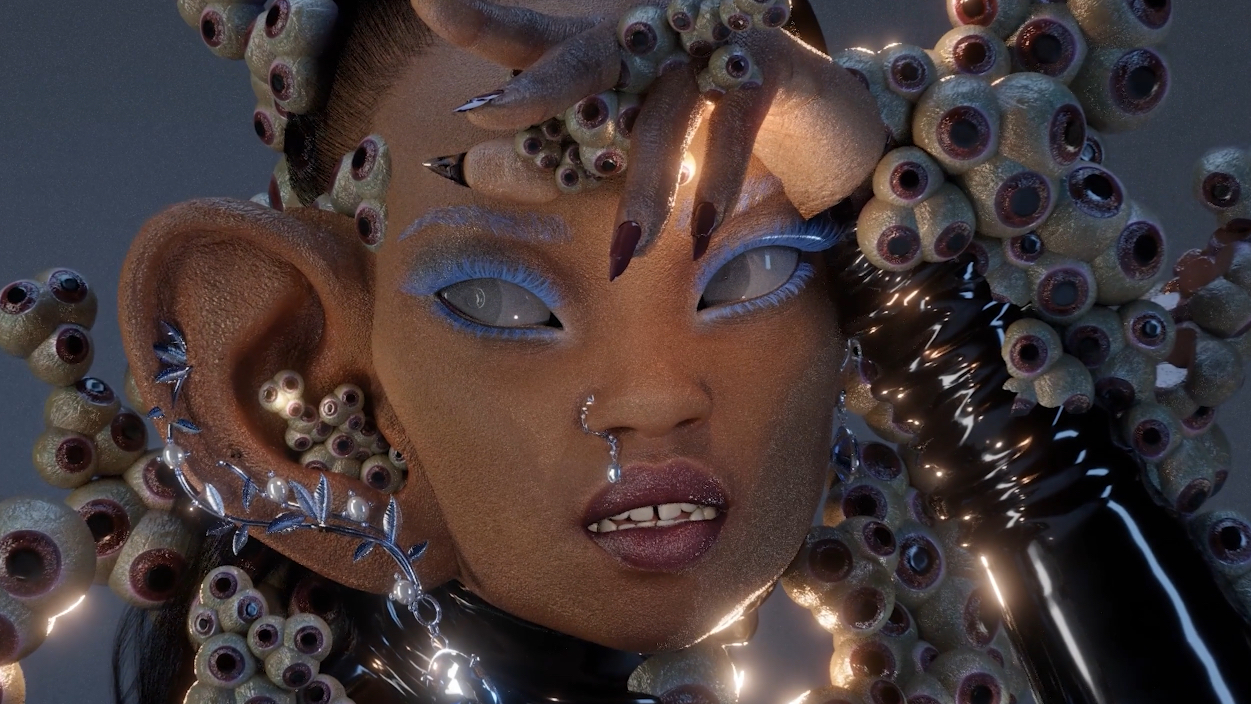
In these works, the gendering of technology takes center stage through the allegorical figure of the “vigilante,” a kind of 3.0 version and equally interspecies of Medusa; the avatar whose body is covered in eyes and ears leads viewers through a dystopian adventure that traverses aspects such as the obsession with the gaze of otherness, dysphoria and fascination with error, metamorphosis, and the inversion of perspectives between self and other, prey and predators.
Expanding on the artist’s research into the field of expanded audiovisual media, animation, CGI images, and immersive environments, the _vigilante00 series exudes sensoriality, performing an almost tactile experience of the digital world. In doing so, Cribb brings body and machine closer together in a regime whose ambiguity elevates the logic of the avatar to a level that is not only aesthetic, but also ethical. Faced with the sensual, soulful, dangerous, and equally scatological beauty of the “vigilantes,” we recognize our empathy for these digital beings with whom we develop complex relationships of interdependence, enchantment, and violence.
Between sexualization and the grotesque, Cribb’s work creates an erotic pathos that is an aesthetic-political project supported not only by the bodies and performativities of the avatars, but also, and fundamentally, by the formal elaborations of the audiovisual pieces. Shiny, reflective surfaces—such as bodies and clothing that evoke latex and fetishistic imagery—, settings that suggest wetness, viscosity, and softness, volatile spatialities in which voices with velvety timbres reverberate, a light that not only illuminates but adheres, flows, and fascinates, produce a tactile visuality whose brilliance defies the supposed immateriality of the digital and evokes the desire to go through the screen to grope into other possible worlds—or, in a more tragic and politically realistic dimension, to disobey distancing and trespass on the limits of otherness that Vitória Cribb presents to us as a Black woman, half animal, half machine.
In this way, Cribb plays with the regimes of visibility inherent to the digital universe, confronting our attraction to the brightness of screens with the “discourse of light” historically fictionalized by the supremacist project sustained by patriarchy and its “cistem.” Looking at works such as _vigilante00, we recognize ourselves as insects flying around a lamp, and thus realize how fanciful the Enlightenment discourse is, which, even today, cynically persists in exclusively attributing to a handful of humans—and their societies—the supposed ability to illuminate the lives of others.
In this regard, Vitória Cribb’s recent participation in such exhibitions as New Humans (New Museum, New York, 2026), Arteônica (Museum of Latin American Art, Los Angeles, 2024), and PLAYING ENTITY (esc medien kunst labor, Graz, 2024) shows her active involvement in the contemporary debate that the arts have generated regarding the limits of modern humanism and its implications for racism, sexism, and speciesism. At a time of escalating femicide and genocide in different regions of the planet, Cribb’s poetic body demonstrates not only its relevance, but also its urgency.
___________________________________________________________________________________________
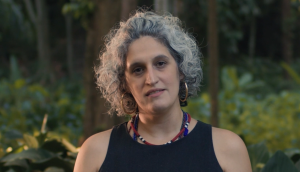
Clarissa Diniz is an educator, curator, and writer in the visual arts. Professor in the Department of Art History and Theory at the School of Fine Arts of the Federal University of Rio de Janeiro (EBA/UFRJ), Diniz holds a Master’s degree in the Arts from UERJ and a Ph.D. in Cultural Anthropology from UFRJ. She served as Content Manager at the Museu de Arte do Rio – MAR (2013–2018), assistant curator of the Programa Rumos Artes Visuais 2008/2009 (Instituto Itaú Cultural), a researcher for Documents of 20th-century Latin American and Latino Art (MFAH, USA), a guest curator at the Centre for Curatorial Leadership 2014 (MoMA, USA), and for the ARA History of Art Residency 2022 program (Witwatersrand University, Johannesburg, South Africa). Between 2006 and 2015, she was editor of Tatuí, an art review journal. Diniz has published numerous articles, catalogs, and books and participated in the 17th and 21st editions of the Videobrasil Biennial as a panelist. Among her recent curatorial projects, the following stand out: MEME: no Br@sil da memeficação (CCBB, 2025–2026), Montez Magno: Algúria (Pinacoteca de São Paulo, 2023), and Histórias Brasileiras (MASP, 2022).
VIGILANTE_EXTENDED | _vigilante00 series
Vitória Cribb, 2022
Video, 8’32”
Vigilant avatars observe the movement of others in cyberspace, remaining static and distant, watching who observes and admires them. They take on different shapes by listening and seeing glimpses of others through the screens. Tip: don’t look for answers in their eyes.
The SCI-FI narrative presents the story of the “Vigilante” characters, created by Cribb since 2021, in an ongoing series called _vigilante00. In this short film, the Director desiccates and contextualizes the narrative behind these characters that live in another world – the cyberspace – however they are always observing, listening and trying to communicate with us (humans) in a careful way, through the shiny screen that separates our worlds.
CREDITS
Directed, written and produced: Vitória Cribb
CGI Artist: Vitória Cribb
Translator: Moises Olmos
Sound Producers: Anelena Toku and OLHO
Master and Mix: Ramon Silva
Commissioned by: Denver Art Museum
BUGs | _vigilante00 series
Vitória Cribb, 2023
Video, 05’40’’
The computer-animated video depict the “vigilant” avatar used in other works—a cybernetic character who inhabits virtual space, whose body is covered with eyes and ears, and who continually watches and listens to us through digital technologies. If through the digital body of this character the artist addressed unbridled online surveillance, in BUGs, the unexpected failures and errors of digital machines are alluded to by the virtual body of a beetle, according to the synonymy of the work’s title. The excesses of machines and of human and insect bodies contrast with the aseptic aspect of the digital interface and the online existence. Behind the apparent cleanliness, however, there is the anxious and frightening nature of the mixing between human and inhuman through technology.
CREDITS
Direction, screenplay, and animation: Vitória Cribb
CGI Artist: Vitória Cribb
Mastering and mixing: Ramon Silva
Intern: Kleospatera
Sound production (Track 1): Anelena Toku
Sound production (Track 2): OLHO
Production: BTW Studio
echoes of a wet finger: | _vigilante00 series
Vitória Cribb, 2024
Video, 12’25”
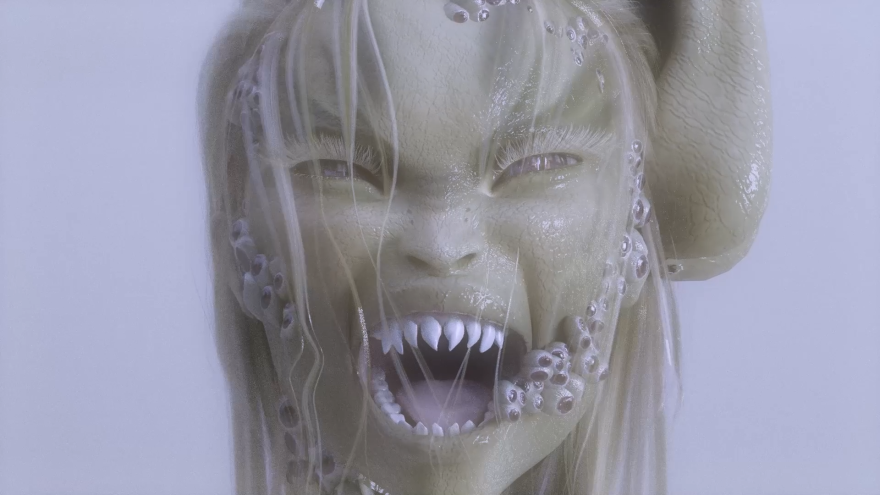
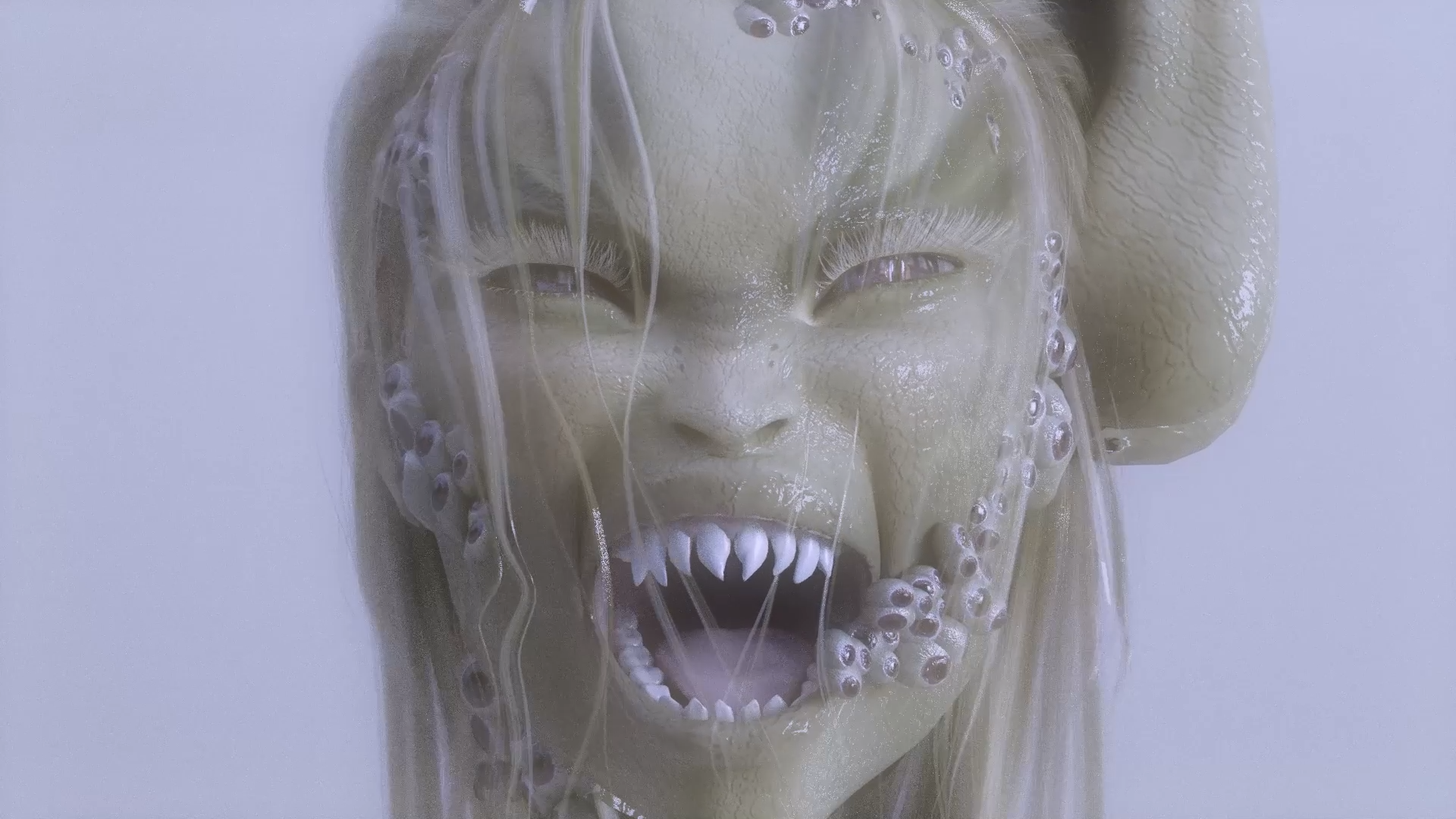
The short film presents Tixa, a woman who, after facing her reflection in the mirror, can no longer ignore the warnings of her dreams. After waking up from a deep sleep, everything seems quiet until Tixa decides to take a shower. Something unexpected happens. A bathroom lizard enters the scene and everything becomes bizarre, yet special. The narrative deals with the idea of the extraordinary during times where the echoes of our thoughts are not listened to. Like the muffled sound of a snap from a wet finger, sometimes our screams can seem like whispers and our desperation surreal.
The artwork was entirely made in Blender 3.5 Software with Support Sharjah Art Biennial 16 and Mercosul Biennial 14, 2025.
CREDITS
Direction, screenplay, and animation: Vitória Cribb
Photography and art direction: Vitória Cribb
Edition: Vitória Cribb
Original soundtrack: OLHO
Voice: Patricia Bello
Mastering and mixing: Ramon Silva, BNSS
Foley: Ramon Silva, BNSS
Production: Vitória Cribb, BTWN